

Top-performing students don’t succeed because they are simply “smarter.”
They succeed because they operate differently.
Research in educational psychology and performance science consistently shows that high-performing students rely on systems, habits, and structured behaviors—not bursts of motivation.
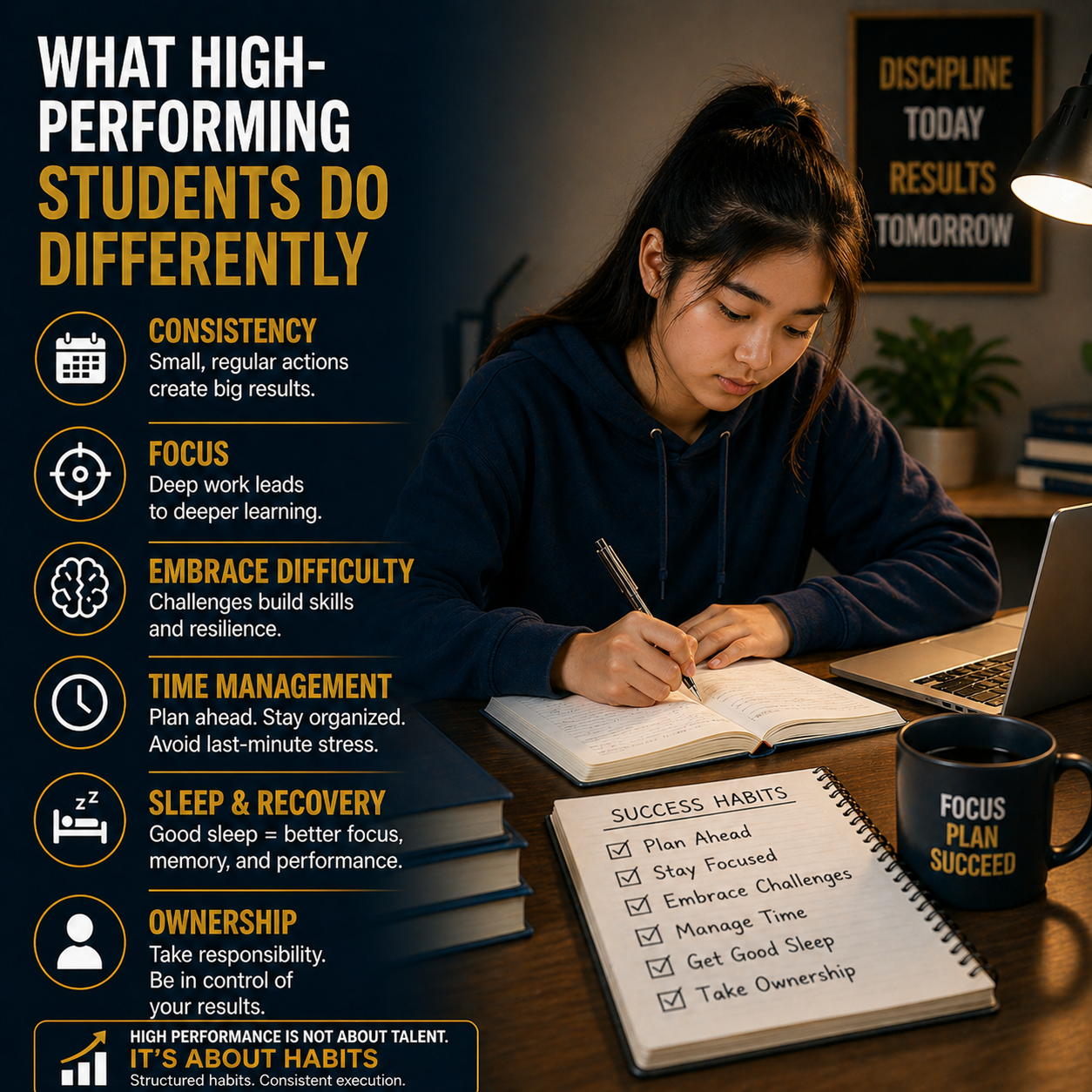
One of the biggest differences is consistency.
Studies have shown that students who follow regular study schedules outperform those who rely on last-minute preparation. Spaced repetition and consistent review lead to stronger memory retention and deeper understanding compared to cramming.
Another key factor is focus.
High-performing students tend to work in focused blocks of time with fewer distractions. Research on attention and productivity shows that deep, uninterrupted work leads to significantly higher-quality learning than fragmented, multitasking-based study sessions.
They also approach difficulty differently.
Instead of avoiding challenging material, high-performing students engage with it directly. Studies on growth mindset and deliberate practice show that students who embrace difficulty and persist through it develop stronger problem-solving skills and long-term academic resilience.
Time management plays a major role as well.
Rather than reacting to deadlines, top students plan ahead. They break assignments into smaller steps, prioritize effectively, and avoid the stress cycle that comes with procrastination.
Sleep and recovery are also critical.
Research from sleep science and cognitive performance studies shows that students who get adequate sleep perform better on tests, maintain stronger focus, and process information more efficiently.
But perhaps the most important difference is ownership.
High-performing students take responsibility for their outcomes. They don’t rely on reminders or external pressure. Instead, they develop internal systems that guide their behavior—showing up, staying focused, and following through consistently.
The pattern is clear:
High performance is not the result of talent alone.
It is the result of structured habits, consistent execution, and disciplined behavior over time.
When students begin to adopt these patterns, their results improve—and more importantly, they begin to see themselves differently.
They don’t just perform better.
They become high-performing individuals.