
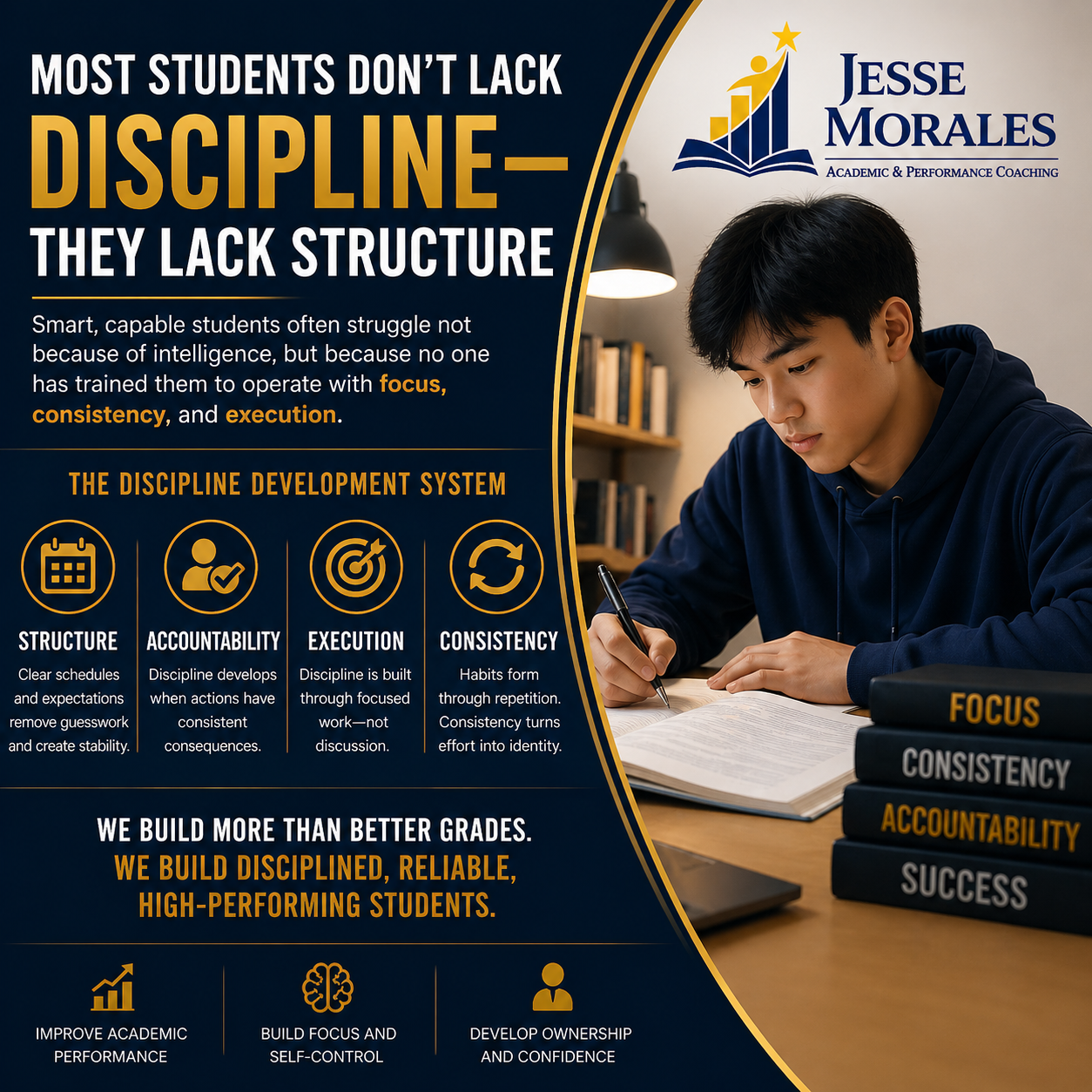
WHY DISCIPLINE FAILS WITHOUT STRUCTURE
Most students don’t struggle because they lack intelligence.
They struggle because no one has trained them to operate with structure, consistency, and accountability.
This is one of the most misunderstood issues in education today.
Parents often see a lack of discipline as a motivation problem.
In reality, it is almost always a structure problem.
When students operate without a clear system, they rely on how they feel in the moment. If they feel focused, they work. If they feel distracted, they avoid. If something is difficult, they delay.
Over time, this creates inconsistency—and inconsistency leads to poor performance.
The problem is not the student.
The problem is the absence of a system that trains discipline.
DISCIPLINE IS NOT BUILT THROUGH MOTIVATION
Motivation is unreliable. It comes and goes.
Students who rely on motivation tend to:
- Start strong, then lose focus
- Avoid challenging tasks
- Procrastinate until pressure builds
- Depend on reminders to stay on track
This creates a cycle of stress, incomplete work, and underperformance.
Discipline, on the other hand, is built through structure.
When expectations are clear and consistent, behavior begins to stabilize.
THE SYSTEM THAT BUILDS DISCIPLINE
In my coaching, I use a structured system designed to develop consistency, focus, and accountability over time.
It is built on four key elements:
STRUCTURE
Students perform best when expectations are clear and consistent.
Sessions are scheduled in advance, start times are defined, and last-minute decision-making is minimized.
Structure removes guesswork and creates stability.
ACCOUNTABILITY
Discipline develops when actions have consistent consequences.
Missed or late sessions are still counted, and expectations are applied consistently.
Without accountability, students default to convenience.
EXECUTION
Discipline is built through focused work—not discussion.
Students are trained to concentrate, work through challenges, and complete tasks effectively during sessions.
They build discipline by doing.
CONSISTENCY
Habits form through repetition.
Regular sessions and stable routines create long-term behavioral change.
Consistency turns effort into identity.
WHAT PARENTS BEGIN TO NOTICE
When this system is applied consistently, students begin to change.
They show up on time without reminders.
They stay focused longer.
They complete work with less resistance.
They take more ownership of their responsibilities.
This is not just academic improvement.
It is behavioral change.
Students begin to operate with more discipline, independence, and reliability.
WHAT THIS REQUIRES
For this system to work, consistency is essential.
Sessions must be scheduled and respected.
Last-minute changes should be minimized.
Expectations must be reinforced consistently.
Flexibility is possible—but only after consistency is established.
Consistency earns flexibility.
FINAL THOUGHT
Discipline is not something students are born with.
It is something they are trained to develop.
When the right structure is in place, discipline is no longer something students struggle with.
It becomes how they operate.